
Why NC superintendents went to Wales to learn about community schools
March 9, 2026
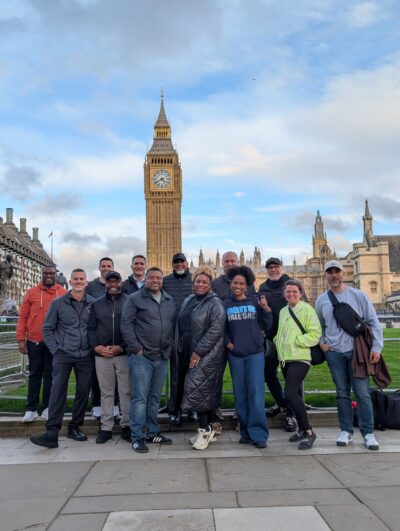
by Melanie Shaver, EdNC.org | March 4, 2026
Editor’s note: The author was recently part of a group that traveled to Wales to learn about community schools. The follow article documents her journey and reflections throughout the trip. Here is more information about the trip and the delegation.
Alongside fellow eastern North Carolina superintendents and staff from East Carolina University, I have been in Wales for a learning exchange focused on community schools. This opportunity, supported by ECU’s Rural Education Institute, allows us to study how an entire nation integrates schools, families, and community services into one aligned system.
In Hyde County, our schools are already anchors. They are learning places. They are gathering places. They are where children find their voice and define their future. They are places where resources and opportunity are provided.
This has expanded thanks to the work being done by Angie Kerr in her new role as Community School Coordinator at Mattamuskeet School. This trip allows us to see what happens when that belief becomes national policy.
Wales has built a countrywide, community-focused school model.
No matter where I go or who I have the honor of speaking with, I always advocate that ALL communities deserve world-class systems.
ZIP codes shouldn’t define outcomes. Rural is not a deficit. It is a context. And context should never cap possibility.
I am overwhelmingly grateful for the opportunity to represent Hyde County and northeast North Carolina.
Place matters
Today we arrived in London and then traveled to Wales. After leaving Heathrow Airport, our first stop was Paddington Station before we caught the train to Cardiff. Michael Bond surely left a legacy when he wrote about that troublesome bear from the deepest darkest jungles of Peru that loves orange marmalade.

The trip from London to Cardiff, showed a countryside dotted with cities, communities, farms, and waterways. Although the architecture is different, as I eat Sunday roast in a small pub and hear the locals talk, yell at the soccer game, and sing (some songs I know, some I don’t), one common thread between home and the United Kingdom is pride in our place.
Community schools are not programs. They are ecosystems. They are rooted in place.
I didn’t need to go to another country to know that place matters. Hyde County is shaped by water, resilience, tight-knit, hard-wording families, and deep generational ties. Understanding how Wales aligns culture and education will help us think about how to honor our own local identity even more intentionally.
How can we live globally but think locally?
This trip is not about copying another country: Wales is different, we are different. It is about understanding systems thinking. I cannot wait to dig in with the ministry to learn more.
Thinking of superintendents as improvement partners
Today our delegation learned about the folklore and history of Wales and met with Welsh leaders to better understand how community-focused schools operate at the national level.
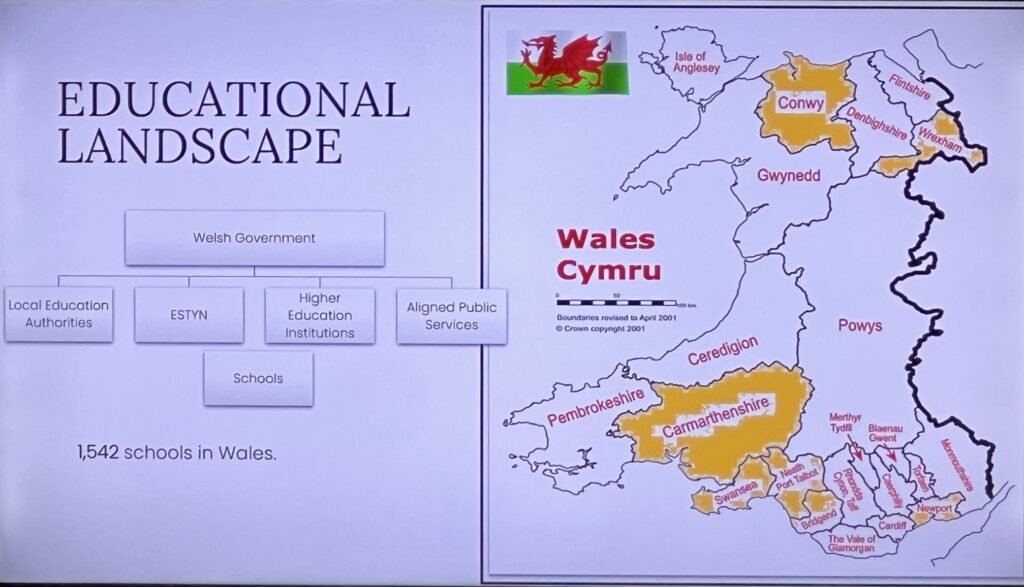
The Welsh history is a rich one, with over 600 known castles and some that date back to the Bronze Age. I learned about the Patron Saint Dewi Sant (Saint David), who insisted that we do the little things and the big ones will fall into place. I learned about St. Dwynwen, the saint of Welsh love and sick animals.
Along with the stories of Branwen, Pair Dadeni, and the Giant Bendigeidfran — who let his troops walk across him as he served as a literal bridge across the river (proving the moral that “He who is a leader should be a bridge”) — as well as Gelert the faithful hunting dog that was killed in a moment of rash reaction highlighting the importance of thinking carefully before acting.
I learned that Beibl William Morgan, a bishop, translated the Bible into Welsh, standardizing the language and preserving it. And how, at one point in Welsh history, education was wielded as a weapon to shut down local Welsh culture by discouraging children from speaking Welsh or recognizing their local ties.
Learning the history and local context, I saw so many similarities between the social, economic, educational, and environmental changes in our own local histories.
When they spoke of cofiwch dryweryn — the practices of flooding valleys to bring water to other parts of the United Kingdom — I thought of Tennessee Valley Authority (TVA) in western North Carolina and the water discussions in our own state. I thought about the ditches and work of moving water to shape our landscape in Hyde. When they spoke of the Penrhyn Slate quarry strike, I thought of growing up and the strike at the local mine in Copperhill, Tennessee, and the tensions it caused.
The last statement that I wrote in my notes from my morning session is, “We are strengthened, not by what sets us apart, but by what we share.”
The afternoon conversation with the local government centered on how Wales aligns education, health, family services, and community partnerships within a unified framework. I was especially interested in how they coordinate funding streams, define accountability beyond test scores, and sustain the work nationwide.
For rural districts like Hyde County, alignment matters. We do not have excess layers of staffing or duplicated services. When systems are streamlined and agencies communicate clearly, students benefit. They, too, don’t have the excess staffing or ability to duplicate services. In Wales, the majority agrees and is committed to providing all they can to a student’s education, so supporting learners is a priority. They design their schools as multiagency places. Play is part of policy.
They face the same struggles we do in areas of need: social, experiential, cultural, and educational.
One of the community school managers shared a presentation with us that had a quote that resonated with the group: “Nothing about us, without us, is for us.”
This encouraged everyone to be part of the work and reminded us, as superintendents (called improvement partners in Wales), that the people we serve should always be active participants in the work we do.
How do we build systems that match our commitment?
Today we visited schools and spoke to university partners in Swansea, and what stood out immediately was how intentional everything felt.
Student supports are not layered on as extras. They are woven into the daily rhythm of the school. Family engagement is not an event on the calendar. It is part of the structure. Teacher leadership is not symbolic. It is embedded in inquiry, reflection, and shared decision-making.
One thing that stood out to me was the well-being curriculum integration. With staff firmly believing that before we educate, we have to regulate. Self and supported regulation was evident in visiting classrooms.
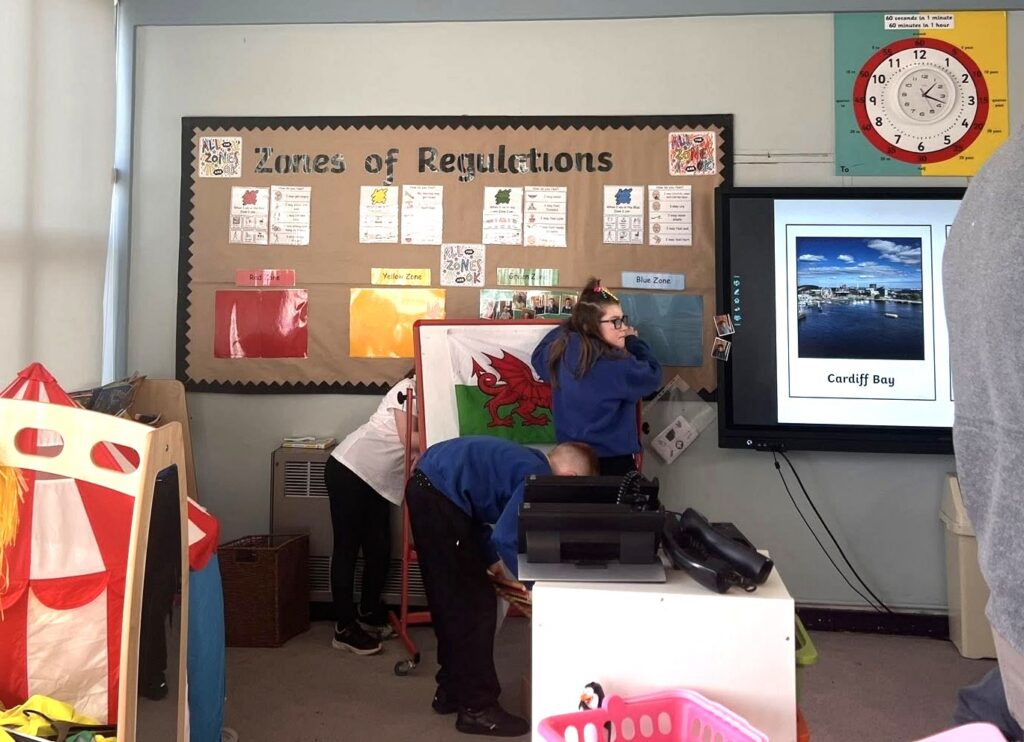
I paid close attention to how services were coordinated. Who owns the work? How is communication streamlined? How are community partners brought into the building in ways that feel natural and not transactional? There was a clarity of roles that allowed educators to focus on instruction and cultivating play while still surrounding students with holistic supports.
The university discussion was equally powerful. Higher education was not distant: it was the theories that guided practice on family engagement.
In Hyde County, our schools often step in where other services are limited. We do it because we care and because our children need us to. But too often that work depends on individual relationships and extraordinary effort. I am reflecting on how we can formalize and strengthen those supports so they are sustainable, clearly structured, and not dependent on any one person.
The question for me is NOT whether we care enough. We do. The question is how we build systems that match our commitment and ensure every child continues to be supported, no matter the circumstance.
Different country, same leadership challenges
Eight hours on a bus today through valleys and mountain gaps that felt stitched together by stone walls, brambles, and glimpses of sun through the fog and clouds. At one point, I looked up and saw a pheasant in the wild, bright and unexpected in the newly greened grass.
Wales has a way of slowing you down long enough to notice things.
We traveled to Wrexham, where we visited Wrexham University and learned more about their research on community-focused schools and how the Welsh school structure operates across local authorities. The policy context matters here. School design, vocational offerings, and supports are often dependent on the local authority, which shapes what students can access.
We also visited Ysgol Clywedog, a secondary school that was designated “Special Measures” in its Estyn reports (similar to being designated low-performing in our N.C. school report cards). About 18 months ago, the school experienced a leadership change. Today, we reviewed the progress the new principal has made and toured the building.
What stood out was not a single program. It was clarity of direction. Focus. Intentional culture-building. Clear expectations.
I enjoyed seeing a culinary class in action. Not all schools in Wales have vocational courses, but where they exist, they create meaningful pathways for students who learn best by doing. It reminded me how powerful applied learning can be, and how extremely grateful I am for our amazing Hyde County Career & Technical Education programs.
Students finish secondary school at 16 (grade 10) after their GCSEs (General Certificate of Secondary Education), and can further their education for two more years until 18, and then at a higher education institution or a vocational school. Welsh honey (which I have tasted but haven’t seen any for sale) is delicious, and two of the schools we have visited tout their student bee hives.
Across conversations today, the themes felt familiar:
- Teacher recruitment
- Youth opportunity
- Student and staff wellbeing
- Cell phones in classrooms
- Student behaviors
Different country. Same leadership challenges.
In every community-focused school we have visited, one truth is consistent: When students feel safe, when they belong, when their basic needs are met, and when their well-being is protected, they thrive.
That is not a Welsh truth.
That is a universal one.
A crossroads where theory meets lived reality
Today we visit Pencoed and Maindee schools and the joy of students, teachers, and parents was evident. The voice of students, parents, and staff convening as one with one goal: What can we do to support our kids?
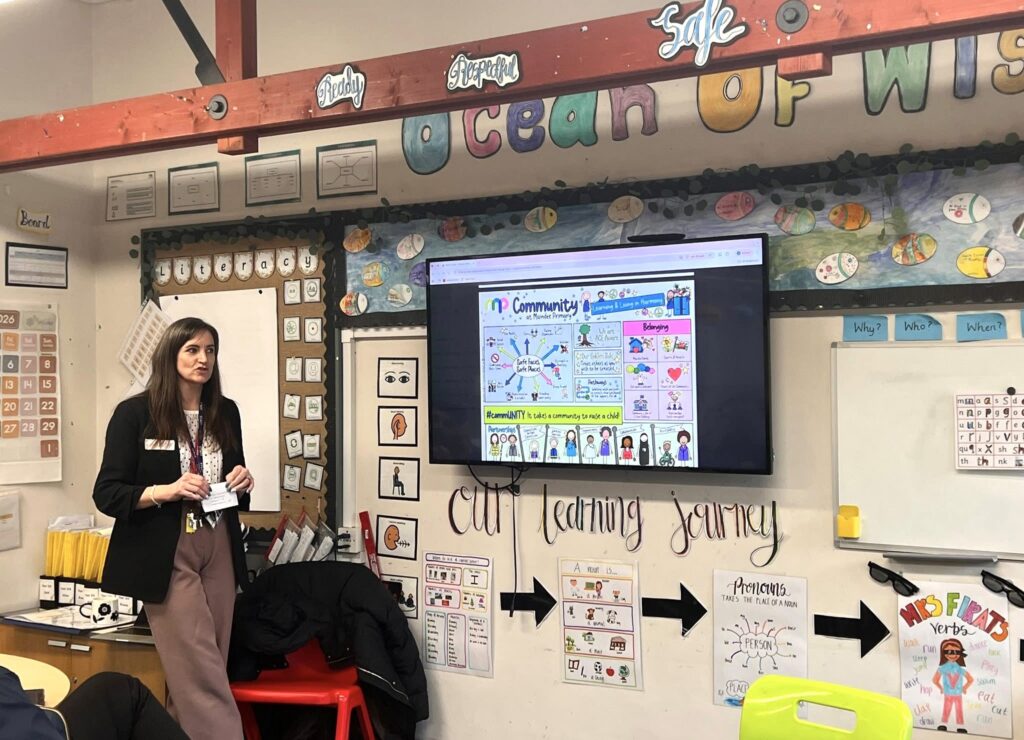
Parents, you are the expert on your child.
Educators, you are the expert on what each child has to learn.
But if we are all working together, the magic that can happen is astonishing!
We are at a crossroads where theory meets lived reality.
Community schools are about:
- Collaborative leadership
- Holistic student and family support
- Data-informed continuous improvement
Community schools isn’t another program or strategy, it’s about place. It’s about ensuring that the services and supports kids need are in the space where they are needed. Whether in Wales or Hyde County, we must build systems that are strong enough to last beyond personalities or grant cycles.
How to bring this learning home
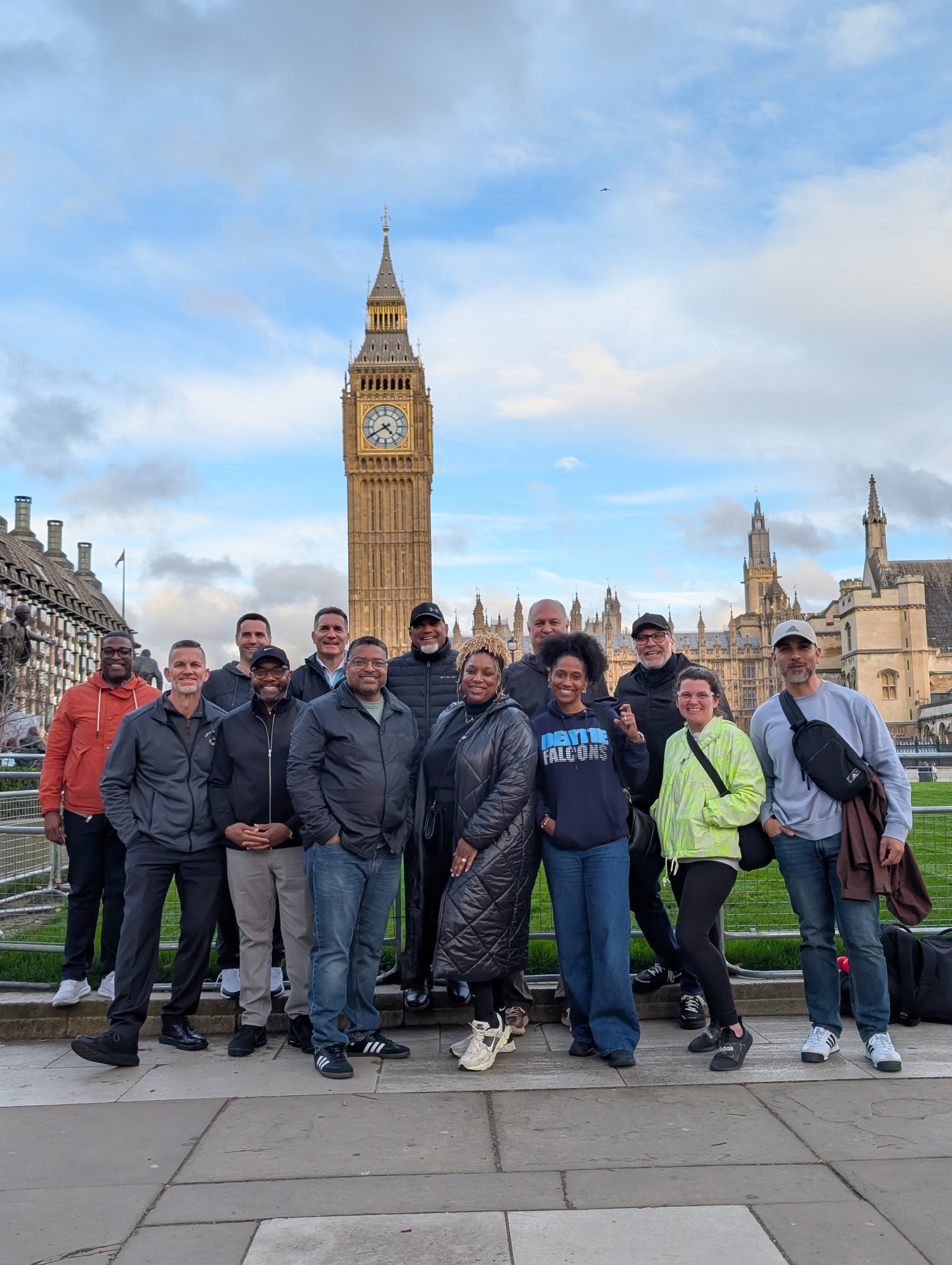
Today our North Carolina team began planning how to bring this learning home. This is more than a one time experience. It is in the work we do everyday.
This trip was not about inspiration alone. It’s about intentional implementation.
Hyde County may be small, but rural innovation often begins in small places. We have strong relationships and clear purpose. The work is well-underway, with the efforts of Tim O’Shea Jr. and the Community School Coordinator at Mattamuskeet School, and organically with Jeanie Owens and her team at Ocracoke School.
I am proud of what our schools, and all the students, the staff, the community have accomplished together. I am grateful to our community that pushes in and loves our kids and our schools. I am excited for all that is to come.
As we make our way home, I am thinking less about the miles traveled and more about the connections formed.
This week has been about more than school visits and policy conversations. It has been about relationships.
Relationships with Welsh educators who opened their schools and their stories to us. Relationships with university partners studying community-focused schools. Relationships with foriegn government leaders that are working to align systems around children. And relationships with fellow eastern North Carolina superintendents who shared this experience side by side.
I am reflecting on the idea that education is local, but learning is global.
Wales reminded me that rural communities across oceans share common hopes:
- Strong schools
- Healthy families
- Thriving communities
Hyde County is not behind. We are not small in vision.
We are part of a broader movement redefining what
rural education can be.
Culture and identity are not separate from education
One of the most powerful takeaways from this trip was that culture and identity are not separate from education, apparent from walking the centuries-old streets and seeing buildings older than our country, to the intentionality that the Welsh have put into designing their schools to be hubs for services and resources within their community.
Culture and identity, instead, are foundational to it.
Wales has preserved its language, honored its history, and intentionally designed schools to reflect local context. That resonated deeply. Hyde County, too, is shaped by water, resilience, tight-knit families, and generational pride. We do not need to become something else to improve. We need to tweak the systems that honor who we already are.
Across every school we visited, one universal truth was clear: When students and staff feel safe, when they belong, when their physical needs are met, and when their well-being is prioritized, they thrive not only socially and behaviorally but also academically.
That is not Welsh. It is human.
Perhaps one of the most meaningful aspects of the trip was the time spent with fellow superintendents. Learning together built regional coherence and trust.
Collaboration among rural leaders may be one of the most underutilized strategies for improvement.
A year from now, success will not be measured by what we admired abroad. It will be measured by what we intentionally strengthened at home. Clearer system alignment. Stronger partnerships. Deeper student and family voice. Sustained culture-building.
Traveling to Wales mattered because it reminded us that rural communities deserve thoughtful design, coordinated support, and high expectations. It reminded us that while education is local, learning can be global.
And it reaffirmed that leadership, at its best, builds bridges so that children can cross into opportunity.
This article first appeared on EdNC and is republished here under a Creative Commons Attribution-NoDerivatives 4.0 International License.