Planting Seeds Across District Lines: Inside the First Community Schools Teach-In of 2025–2026
March 2, 2026
by Brittany Gregory, ncforum.org
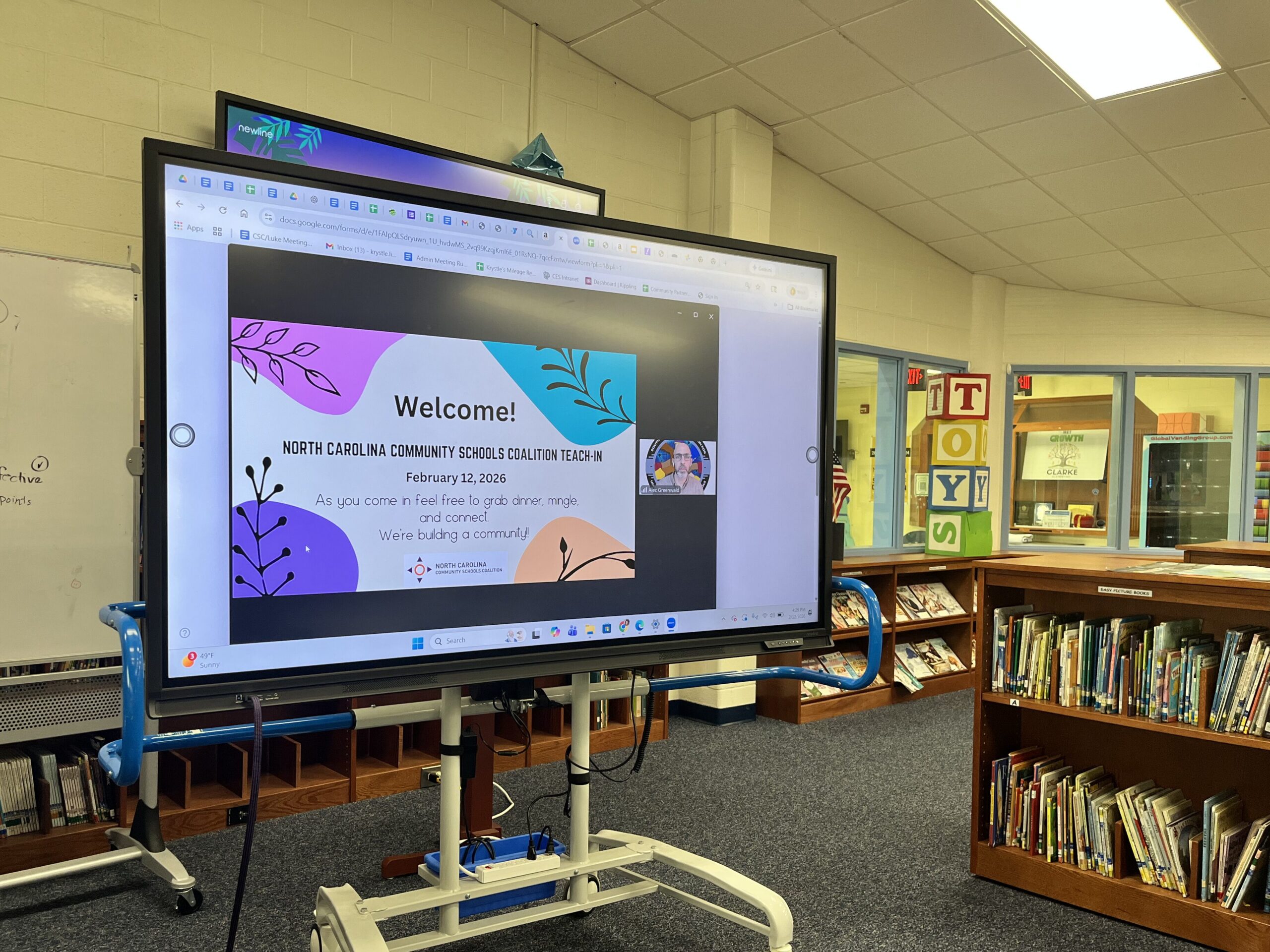
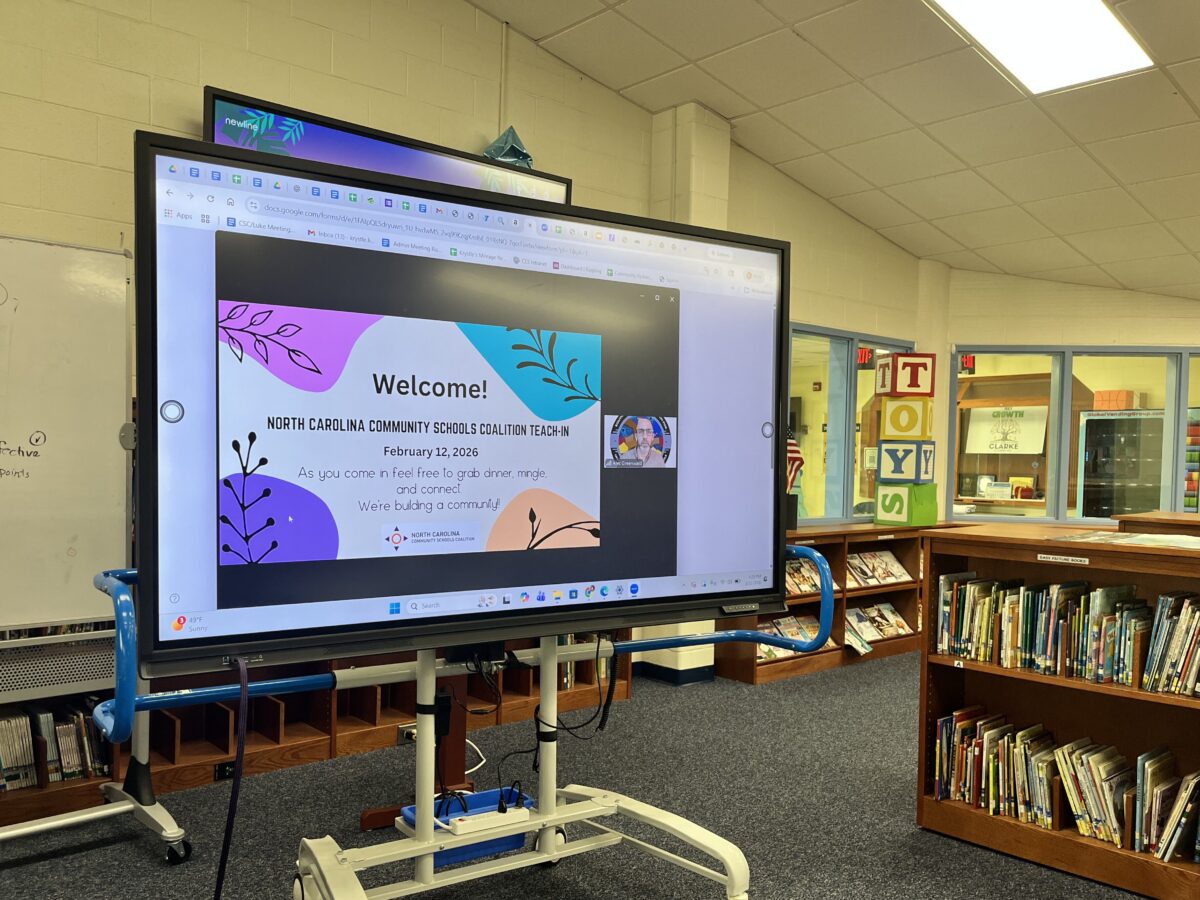
On February 12, nearly 100 educators, coordinators, higher education partners, and district leaders gathered across North Carolina for the first Community Schools teach-in of the 2025–2026 academic year. While connected virtually as one statewide community, participants met in person at various host sites, creating a layered experience rooted in both local relationships and shared learning.
From P.W. Moore Elementary in Elizabeth City to Mattamuskeet High School in Hyde County, from Roseboro-Salemburg Middle in Sampson County to Lakewood Elementary in Durham, cohorts assembled in their own districts while remaining linked to a broader network spanning districts. In Asheville and Buncombe County, educators met at the United Way. In Orange County, they gathered at Central Elementary. In Vance County, at Clarke Elementary. In Bertie, Washington, and Northampton counties, local teams convened in their respective schools. Each site carried its own soil — its own context, needs, and strengths — yet all were connected by a common framework.
The teach-in was organized through the Southeast Regional Coalition for University-Assisted Community Schools, a partnership model through the NC Community Schools Coalition that links higher education institutions with K–12 schools and communities. The approach is grounded in the belief that research, resources, and expertise are most effective when translated into locally responsive strategies. Rather than delivering top-down solutions, the model emphasizes co-learning, adaptation, and professional development that strengthens district capacity over time.
The evening began with an interactive roll call that brought each host site onto the screen in turn. Educators waved, laughed, and greeted colleagues across regions. The playful moment underscored a serious truth: Community Schools work is built on relationships. The statewide network may be broad, but its strength lies in the roots — in the trust built within districts and the connections strengthened through in-person gatherings.
The stated goals of the evening reflected this dual focus. First, to deepen relationships within each district cohort. Second, to introduce innovative Community Schools practices from across the country that could be adapted locally. The emphasis was not replication. It was cultivation.
If the model creates the garden bed, each district determines what will grow in its own climate.
A Case Study in Youth Leadership
The featured presenter, Richard Gijon, Community School Coordinator in the San Diego Unified School District, offered a case study from Hoover High School that served as the central learning example of the evening. His presentation focused on youth leadership and student voice — not as an accessory to the Community Schools model, but as an organizing principle.
At Hoover High, what began as a traditional campus food pantry eventually transformed into something more expansive and more student-driven. Students had identified a problem that adults had not fully named: while the pantry provided food, it did not always preserve dignity. Some students were missing school in order to work and contribute financially to their families. Food insecurity was intertwined with attendance, economic pressure, and wellness.
Rather than designing a solution for students, adults created space for students to lead.
The result was the Hoover Market, a student-informed and student-designed campus market addressing food accessibility with attention to dignity and choice. Students collaborated with school staff, used their woodshop to build physical infrastructure, and worked alongside campus construction teams. They connected the market to broader efforts around wellness, mental health, garden spaces, and family support. What had once been a service became a system — and students were co-owners in its design and implementation.
Gijon described multiple modalities of student voice: informative, consultative, co-creative, and youth-led. At Hoover, leadership was distributed rather than symbolic. Students were not surveyed and thanked. They were empowered and supported.
The Community School Coordinator and the Community Schools framework provided backbone support, ensuring the work maintained fidelity to the model. Adults built guardrails and offered guidance, but they also relinquished a degree of control. The shift required intentional changes in mindset. It challenged the longstanding assumption that students should be seen and not heard.
The example resonated across districts. In reflecting on the presentation, participants considered where student voice might be constrained by adult urgency or system pressure. Curriculum pacing, testing requirements, and time constraints are real barriers in public schools. Yet the Hoover example suggested that youth leadership does not compete with academic goals. It strengthens them by increasing belonging, engagement, and ownership.
Small entry points can make a difference: embedding voice into morning meetings, writers workshops, advisory structures, or school improvement conversations. Early wins build trust. Trust builds momentum. Momentum sustains change.
In this framing, youth voice is not a program layered on top of school structures. It is a sustainability strategy that allows schools to respond to real conditions facing students and families.
The Power of Shared Learning
While the Hoover High story anchored the content of the teach-in, the structure of the evening demonstrated another core principle of University-Assisted Community Schools: learning is reciprocal and ongoing.
District teams did not simply log in to receive information. They gathered physically, shared meals, and reflected together in real time. After the presentation, cohorts discussed how youth leadership might look in their own schools. What seeds could be planted now? What existing efforts could be nurtured? Where would adaptation be necessary?
This is the quiet strength of the Community Schools model when paired with university partnership. Higher education institutions contribute research, technical assistance, and broader networks. Districts contribute lived experience, community knowledge, and local leadership. The result is not a standardized product, but a shared professional development ecosystem.
In a state with diverse geographies — from the mountains to the coast — such shared learning matters.The principles can travel. The soil determines the specifics.
As the evening concluded with reflection and survey responses, participants logged off from their individual sites but remained connected through a broader vision. Community Schools, like public roads, are collectively owned. The infrastructure may be formalized through coordinators and partnerships, but the work belongs to the community.
Seeds were planted — in students learning to lead, in adults learning to listen, and in districts strengthening their roots together. The harvest, as always in public education, will take time. But the conditions for growth are being intentionally cultivated.